Bottom line
Naples Airport is not a land-sale windfall — it is a governance and operating-instrument question. A 2026 state law changed board selection and related membership rules, and the City went to court and to a statutory conflict-resolution process over it. The law did not itself transfer title, amend the lease, or alter federal obligations. Board composition affects agreements, facilities, budgets, and noise-management policy, while federal access obligations constrain any local veto over eligible carrier access. This dossier takes no side; material factual claims point to numbered sources or are expressly qualified.
Executive summary
- The asset: Naples Airport covers approximately 732 acres. The Naples Airport Authority reports that the City leased the airport to the Authority in 1969 for 99 years, through 2068, at annual rent of $1. The dollar is reported lease rent, not a purchase, sale, option, appraisal, redevelopment entitlement, or offer to redevelop airport land [1].
- The trigger: CS/HB 4005 (2026) changed board selection and related membership rules, including qualifications, terms, vacancies, eligibility, and compensation provisions. It did not itself transfer title, amend the lease, or alter federal obligations [2].
- The dispute: the City filed suit (then moved to abate it) and opened a Chapter 164 intergovernmental process; the Authority opened its own. The City has proposed ending the lease and re-anchoring governance at city hall; the Authority's counter would codify its operational independence.
- The new pressure: American's May 13 letter of intent was not operating service. On July 2, the Authority reported that tickets were on sale for planned December 2 service while a use agreement, terminal work, and TSA approval remained outstanding. An NAA-commissioned survey of 633 registered voters reported 80.3% favorable, with a ±3.9% margin of error at 95% confidence; it was opinion research, not a vote [11][18].
- Why it can't be treated as a simple windfall: federal obligations generally restrict diversion of airport revenue. Conversion or disposition of federally obligated airport property generally requires FAA review or release, depending on the parcel, governing instrument, and applicable obligation [20].
The $1 fact is a lease fact. It is the reported annual rent under the 1969 lease terms; it is not a purchase price, sale price, option price, appraisal, redevelopment entitlement, or offer to redevelop airport land.
A letter of intent is not service. As of the June 18 edition, American's May 13 document was a letter of intent, no use agreement had been approved, and operating commercial service had not begun [11][18].
A survey is not a vote. The NAA-commissioned survey of 633 registered voters reported 80.3% favorable, with a ±3.9% margin of error at 95% confidence. It is opinion research, not an election, referendum, governing-board vote, or public approval [11][18].
Standout statements
- This is a control question, not a land-sale windfall.
- Federal obligations generally restrict diversion of airport revenue, and conversion or disposition of obligated property generally requires FAA review or release.
- HB 4005 changed board selection and related membership rules. It did not itself transfer title, amend the lease, or alter federal obligations.
- Board composition affects agreements, facilities, budgets, and noise-management policy, but federal access obligations constrain any local veto over eligible carrier access.
- The durable civic win available to either winner is the edge — the perimeter — not the acreage.
- This publication takes no side. Material factual claims are footnoted or expressly qualified; the public source list is available to every reader, and corrections are invited with documentation.
Scope note (plain English): This dossier is an interpretation of the public record. It is not a claim that any Bitcoin, mining, energy-monetization, partnership, or proposal is currently under consideration for Naples Airport or by any party — and nothing here implies any endorsement, proposal, partnership, or agency approval. "Civic Bitcoin" is the name of the research platform; the analysis is civic and financial — a balance-sheet reading — and it proposes nothing. It contains no investment language and no yield, ROI, or mining-return claims.
Naples Airport is not a land-value story. It is a civic balance-sheet fight over control, noise governance, public trust, commercial-service pressure, and the airport-city edge.
Why this matters now
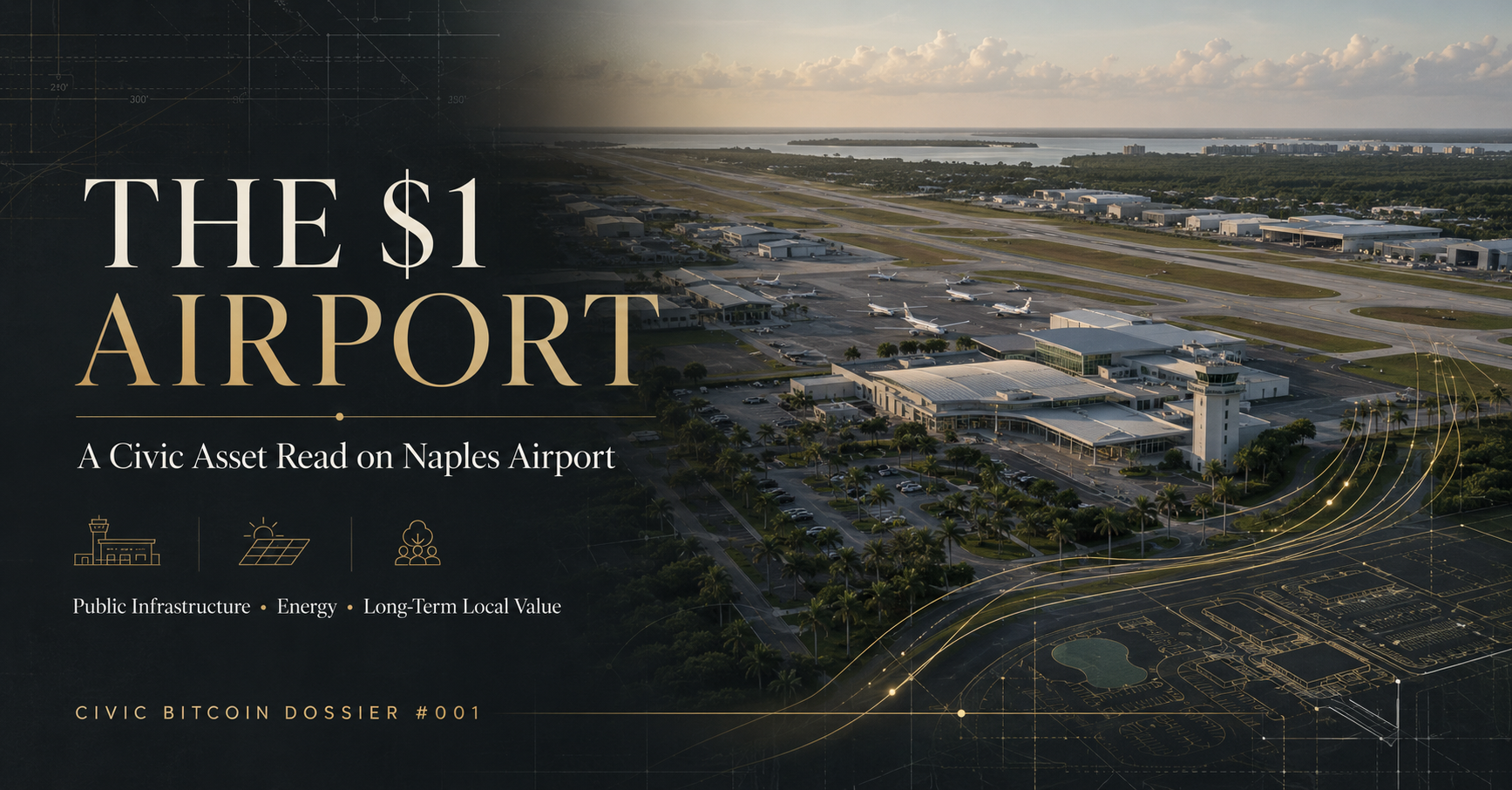
The City of Naples and the Naples Airport Authority are in a formal, statutorily structured conflict over Naples Municipal Airport. The airport covers approximately 732 acres. The Authority reports that the City leased the airport to it in 1969 for 99 years, through 2068, at annual rent of $1 [1].
The trigger was a state law. CS/HB 4005 — passed the Florida House 112-1 and the Senate 36-0, signed April 6, 2026, effective on signing — changes how the Authority's five-member board is selected and also changes related membership rules covering qualifications, terms, vacancies, eligibility, and compensation. It did not itself transfer title, amend the lease, or alter federal obligations [2].
The City's response moved fast. On April 15, council adopted Resolution 2026-15847 — authorizing its attorney and manager to initiate litigation "not to exceed $125,000" — and initiated Florida's Chapter 164 intergovernmental conflict-resolution process by letter the next day, April 16 [3][4]. On May 4 the City filed suit — City of Naples v. City of Naples Airport Authority, et al., No. 2026-CA-001094, 20th Judicial Circuit — then on May 6 moved to abate its own case while the statutory process runs, as Chapter 164 directs [5][6]. The required joint public meeting was held in two sessions on June 9; the recordings are airing on the city's broadcast channel, and minutes were still pending as this was written [10].
The June 18 edition captured city sessions on the case, the Authority's June board meeting, and the first countywide board election scheduled for November [2][6][11]. A July 2 update is included below. This timing is why the airport became Civic Bitcoin's first case study.
The false frame: this is not simply a land-value story
The simplest story — and you will hear it — goes like this: approximately 732 acres in Naples, leased for a dollar a year. Somebody is sitting on a fortune. Fight accordingly.
That story prices an operating airport like a vacant parcel. It ignores the lease, operating agreements, federal obligations, parcel-specific facts, and the FAA review or release generally required for conversion or disposition of federally obligated airport property.
The three entries
Reported lease position. The Authority reports that the 1969 lease runs through 2068 at annual rent of $1 [1]. The executed lease and amendments remain identified as open verification items in this edition. Any present-value framing is illustrative, not an appraisal, opinion of value, or investment advice.
Control rights. The reported dollar-a-year lease paired nominal rent with a governance arrangement that included a City-appointed board. Interpretation, ours: control was part of the civic value of the position. HB 4005 changed board selection and related membership rules, but federal access obligations continue to constrain any local veto over eligible carrier access [2][10].
Federal constraints. Federal obligations generally restrict diversion of airport revenue. Conversion or disposition of federally obligated airport property generally requires FAA review or release, depending on the parcel, governing instrument, and applicable obligation [20].
For scale, this is no marginal enterprise. The Authority's first-draft FY2027 budget puts operating revenues near $47 million; its audited financials show no debt in fiscal years 2023 through 2025; and it reports being funded entirely by user fees — no local tax dollars — with fuel sales at 68 percent of net operating revenues in its FY2025 financial report [11][12]. The enterprise works. The fight is over who steers it.
What changed under HB 4005
Precision matters, because the maximal versions of this story are wrong in both directions. The law changed board selection and related membership rules. It did not itself transfer title, amend the lease, or alter federal obligations [2].
From the enrolled text: all five seats go on the November 2026 ballot — odd-numbered seats for four-year terms, even-numbered for two, staggered thereafter. Sitting commissioners serve until results are certified; mid-term vacancies are filled by the Governor, not the council; candidates must demonstrate at least five years in financial management, small business operations, or aerospace [2]. These are structural facts about who votes, not predictions about how anyone will.
The conflict record
The City's authorization and theories. Resolution 2026-15847 (April 15, adopted 6-1) authorized litigation under a not-to-exceed $125,000 cap; the Chapter 164 letter followed April 16 [3]. Authority board records describe the City's suit as seeking declaratory and injunctive relief on two stated theories: that HB 4005 undermined the purpose of the 1969 lease, and alternatively that the act did not comply with statutory requirements for an independent special district [5]. City Attorney Matthew McConnell, in April: "The city believed it would always have that power over its dependent special district. The moment that goes away, so does the lease" [4].
Two Chapter 164 tracks. The Authority opened its own conflict-resolution process on April 30 — Resolution 2026-3, adopted unanimously — focused on land use and zoning [9].
The City's written proposal (May 13): terminate the current lease; recreate the airport as a city enterprise fund or new dependent special district; govern it through a seven-member City-appointed board; pursue FAA approval for the City or new district to become the airport sponsor; and, if both sides agree, jointly ask the Legislature to rescind the special act [7]. The Authority's counter (June 9, "only for the purpose of settlement"): a draft city ordinance confining the City's regulatory authority to non-aeronautical development and land use [8].
This publication takes no position on who should govern the airport; the legal questions belong to the parties' counsel. What the documents establish is the distance between the positions.
The new operational pressure
June 18 edition: On May 13, American Airlines submitted a letter of intent concerning proposed service. As of June 18, that document was a letter of intent, not operating service, and no use agreement had been approved [11][18]. July 2 update: the Authority reported that tickets were on sale for planned December 2 service while a use agreement, terminal work, and TSA approval remained outstanding [18]. An NAA-commissioned survey of 633 registered voters reported 80.3% favorable toward restored commercial service, with a ±3.9% margin of error at a 95% confidence level. It was opinion research, not an election, referendum, governing-board vote, or public approval [18].
Board composition affects agreements, facilities, budgets, and noise-management policy, but federal access obligations constrain any local veto over eligible carrier access [10][18].
What actually matters
Noise governance. The airport's noise program produced a D.C. Circuit precedent, anchored by a ban on the loudest class of jets (Stage 2) the Authority reports enforcing since 2002 [14]. When the FAA moved to cut off the airport's federal grants over that ban, the D.C. Circuit granted the Authority's petition — vacating the agency's order as unsupported by substantial evidence (City of Naples Airport Authority v. FAA, 409 F.3d 431, D.C. Cir. 2005); the City filed a brief supporting the Authority [19]. Today the Authority reports 98.2 percent compliance with the voluntary 10 p.m.–7 a.m. curfew over the twelve months ending April 2026, within $8.37 million it reports investing in noise abatement since 2000 [13][14].
Public trust. A governance handoff executed honestly — facts published, processes legible — keeps trust on the town's balance sheet through the transition. Trust is an entry too.
The airport-city edge. The field is productive civic infrastructure: its public-services roster includes the Collier Mosquito Control District, the Sheriff's aviation unit, Collier County EMS MedFlight, Naples Fire Station 3, and a U.S. Customs facility [17]. On the west, ~4,900 feet of the Gordon River Greenway crosses airport land — with another 11,500 feet of connecting path on airport property [15]. On the south and east, the airport meets its city as sun-blasted chain-link, utility poles, and turf [21].
The Edge Compact — a Civic Bitcoin concept
The Edge Compact is this publication's own concept, not a proposal by any party. The idea: whoever governs this asset after the Chapter 164 processes and the November election, the durable civic win available to either winner is the perimeter — complete the Greenway loop where airfield safety allows; replace the public-facing chain-link with dignified fencing and a native hedge; mark the US 41/Davis gateway with a modest wall that tells the field's 1942 story. Planning-grade allowances put it in the low single-digit millions — order-of-magnitude figures, not engineering estimates [16]. Interpretation, ours: the edge is a small entry that buys a large amount of public trust.
What the public record shows
- The Authority-reported airport campus and lease terms (approximately 732 acres, $1 annual rent, to 2068), and HB 4005's board-selection and related membership changes. The $1 figure is not a purchase, sale, option, appraisal, redevelopment entitlement, or offer.
- The litigation (Case 2026-CA-001094, filed 5/4, moved to abate 5/6) and the two parallel Chapter 164 tracks.
- The City's written proposal (5/13) and the Authority's settlement-only counter-ordinance (6/9).
- The June 18 status of the American Airlines letter of intent, the Authority's July 2 ticket-sales update with outstanding conditions, and the NAA-commissioned survey — with the explicit limits that a letter of intent is not service and a survey is not a vote.
- The noise program, the 2005 D.C. Circuit ruling, and the Authority's financials (no debt FY23–25; fuel 68% of net operating revenue).
What the public record does not show
- How the court will rule, or how the Chapter 164 processes resolve.
- How the new countywide electorate will vote in November.
- Whether commercial service happens — use agreements are unsigned and unbudgeted.
- Three items still being verified: the executed 1969 lease text, the June 9 minutes, the 1947 conveyance instruments.
- The FAA's position — no public statement located.
Why this matters
For anyone who governs, builds near, finances, or lives around this field, the governing-board structure changed on a public clock measured in months. Board composition affects agreements, facilities, budgets, and noise-management policy, while federal access obligations constrain any local veto over eligible carrier access. Read as a balance sheet, governance is a material entry — but not the only instrument controlling this airport.
Watchlist at publication (June 18, 2026)
These were the open checkpoints when the June 18 edition was published. They are not presented as current status. The July 2 airline update is stated above; any later material update requires a new dated source entry.
- The June 9 record — two joint sessions rebroadcasting on Naples TV (shows 225/226); minutes pending [10].
- June 15 & 17 — City takes up the Authority's draft ordinance (settlement-only) + executive sessions on the case [6].
- June 18, 8:30 a.m. — Authority board: counsel's report, the commercial-service survey, the first FY2027 budget draft [11].
- November — all five board seats on the countywide ballot (filings reported: Arnold/Seat 2, Mellon/Seat 4) [22].
- The FAA — no statement located; any signal changes the land-use ceiling.
Source scorecard
| Measure | Result |
|---|---|
| Total numbered sources | 22 |
| Primary documents reviewed | 19 |
| Open items, expressly flagged | 3 (executed lease text, June 9 minutes, 1947 conveyance) |
| Unsupported press-only claims | 0 — every press item corroborated or labeled |
| Opinions of value / investment claims | None |
| Position taken on who should govern | None — the public edition and source list are available to all readers |
Forwardable summary
Naples Airport covers approximately 732 acres. The Authority reports that the City leased the airport to it in 1969 for 99 years, through 2068, at annual rent of $1. The $1 is lease rent, not a purchase, sale, option, appraisal, redevelopment entitlement, or offer. HB 4005 changed board selection and related membership rules; it did not itself transfer title, amend the lease, or alter federal obligations. As of June 18, American's May 13 document was a letter of intent, not operating service. On July 2, the Authority reported that tickets were on sale for planned December 2 service while a use agreement, terminal work, and TSA approval remained outstanding. The NAA-commissioned survey is opinion research, not an election, referendum, governing-board vote, or public approval. Federal obligations generally restrict revenue diversion, and property conversion or disposition generally requires FAA review or release depending on the parcel and governing obligation. This Civic Bitcoin dossier takes no side and publishes its source list for every reader.
Method and neutrality note
This analysis takes no position on who should govern the airport. Factual claims use numbered citations to the source list below; the list identifies the records reviewed but does not yet provide a direct hyperlink for every item. Anything we could not verify is labeled unverified, and corrections are invited with documentation. No claim is made that a source packet was delivered to either principal. The public edition and source list are available to every reader. Civic Bitcoin offers no separate private fact set; the public edition and its stated limitations control this publication. Statutory and regulatory summaries here are descriptive, not legal conclusions. Nothing in this dossier implies any endorsement, proposal, partnership, or agency approval, and nothing here is an investment, mining, or energy solicitation.
Sources
(✓ = primary document reviewed; ⏳ = open item, expressly flagged. Corrections welcome with documentation.)
- Naples Airport Authority FAQ: approximately 732 acres; Authority-reported 1969 lease, 99-year term through 2068, and $1 annual rent ✓; executed lease text and amendments ⏳
- Enrolled CS/HB 4005 (2026): votes, board selection, qualifications, terms, vacancies, eligibility, and compensation provisions ✓
- Resolution 2026-15847 (April 15, 2026; not-to-exceed $125,000; adopted 6-1) and April 16 Chapter 164 initiation letter, via Granicus ✓
- Gulfshore Business, April 28, 2026 (A. Cavalier): Heitmann workshop quote; McConnell quotes; process reporting ✓
- NAA board records: May 21, 2026 pre-meeting packet (Executive Director memo: May 4 suit, May 6 motion to abate, the City's stated theories) ✓
- City of Naples June 15 special-meeting agenda, Supplement 1 (Case No. 2026-CA-001094; item 14.H) and June 17 regular agenda (executive session) ✓
- City "Airport Proposal" (May 13, 2026), document via Granicus ✓
- NAA June 9 joint-meeting packet: draft ordinance and settlement-only caveat ✓
- NAA Resolution 2026-3 (April 30, 2026) and April 30 special-meeting minutes ✓
- June 9 joint-meeting record: federal access obligations and local authority discussion ✓; session agendas and Naples TV rebroadcast listings ✓; final minutes ⏳
- NAA June 18, 2026 board pre-meeting packet (166 pp.): FY2027 first-draft budget; AA LOI memo; survey memo ✓
- NAA FY2025 Annual Comprehensive Financial Report (fuel 68% of net operating revenues; no debt FY2023–2025) ✓
- NAA monthly noise report through April 2026 (curfew compliance 98.2%) ✓
- NAA noise-abatement program page (fourth Part 150 study ≈$2M; $8.37M since 2000; FAA Record of Approval December 12, 2024 per board packet) ✓
- NAA Gordon River Greenway page (≈4,900 ft west-quad path + 11,500 ft connecting path on airport property) ✓
- NAA news release May 13, 2026 ($25.4M airfield lighting and electrical-vault project) ✓; groundbreaking May 8 per June 18 board packet ✓; Business Observer May 13, 2026 ✓
- NAA Public Services page (tenant roster) and NAA FAQ (U.S. Customs facility) ✓
- NAA survey methodology and results; NAA July 2 airline update; June letter-of-intent post ✓
- City of Naples Airport Authority v. FAA, 409 F.3d 431 (D.C. Cir. 2005), full opinion (disposition; City–County amici in support of petitioner) ✓
- 49 U.S.C. §47133; FAA property-release guidance; FAA revenue-use policy and grant assurances ✓
- 1942 Naples Army Air Field origin; 1947 return to local hands ✓; 1947 conveyance instruments ⏳
- Candidate filings per the Collier County Supervisor of Elections, as reported by Gulfshore Business, April 28, 2026 ✓
This is source-based civic commentary and interpretation — not legal, tax, investment, appraisal, or election advice. Concept visuals, if any, are not proposed or approved plans.
This work is source-based public research, civic commentary, and interpretation. Civic Bitcoin does not accept applied local or current decision-support work; that belongs at Intelligence Desk. It is not legal, tax, investment, treasury-management, engineering, procurement, appraisal, election, or fiduciary advice. Civic Bitcoin does not execute transactions, select vendors, custody assets, or replace qualified professional review. Concept visuals are not proposed or approved plans. Corrections are welcome with source documentation.